
September 2024
In the business world, changing the course in mid-stream in a project can be distressful, time consumption and costly. For example, you order blue new chairs for the entire office, and just after they are in production, you change them to brown. In contrast, in the design professions and construction industry, changes are commonplace. In fact, they are inevitable. Unanticipated field or concealed conditions, unknown surroundings, modifications due to changed circumstances, and errors or omissions in design or construction are just a few of the situations that may occur.
To accommodate changes in the design and construction industry, professional association documents have devised mechanisms to handle revisions to a project. Certainly, changes during the design of an architectural or engineering (A/E) project will at least involve some time and probably a fee adjustment. But during construction of a project, where the rubber meets the road, things become different.
PROFESSIONAL ASSOCIATION DOCUMENTS
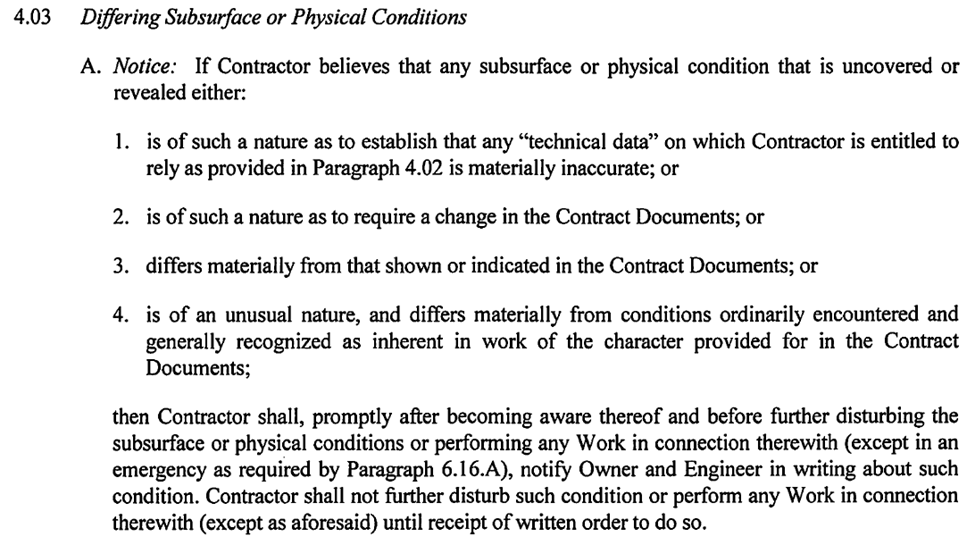
The Engineers Joint Contract Documents Committee (“EJCDC”) Standard General Conditions of the Construction Contract C-700 states that:
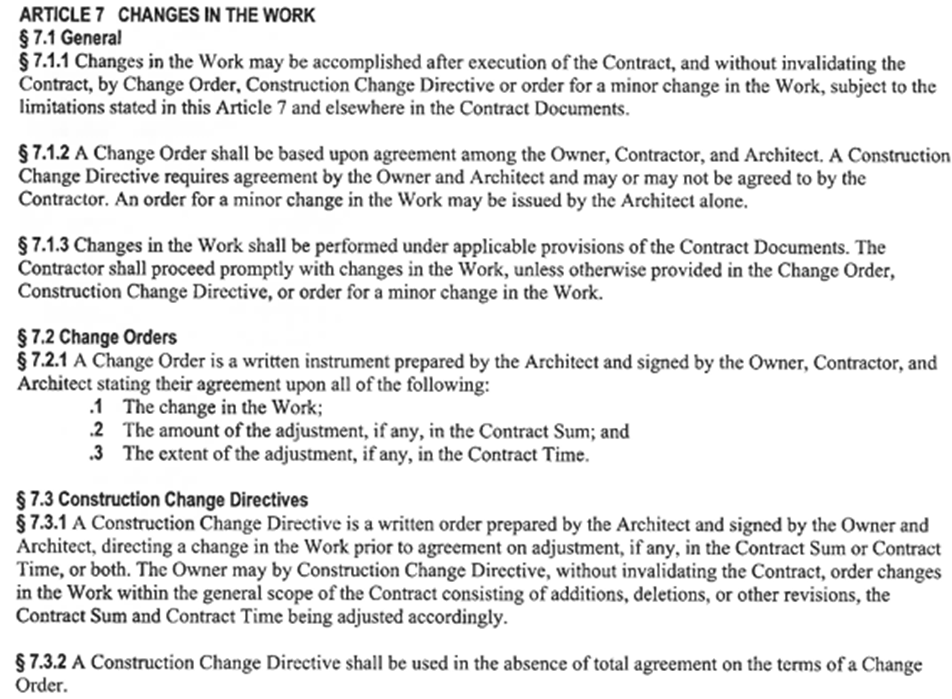
In contrast, the American Institute of Architects’ (AIA) General Conditions of the Contract for Construction, Document A201, has a different approach. There are three options to handle a change during the construction phase of a project. These options are 1) a Change Order, 2) a Construction Change Directive, and 3) a Minor Change of the Work. The AIA A201 Article 7 states:
In contrast, the American Institute of Architects’ (AIA) General Conditions of the Contract for Construction, Document A201, has a different approach. There are three options to handle a change during the construction phase of a project. These options are 1) a Change Order, 2) a Construction Change Directive, and 3) a Minor Change of the Work. The AIA A201 Article 7 states:

AS A REAL-LIFE EXAMPLE
To illustrate how these three options may play out, consider this scenario of a change to the required access for an American Disabilities Act (ADA) ramp to the new seating at a high school stadium.
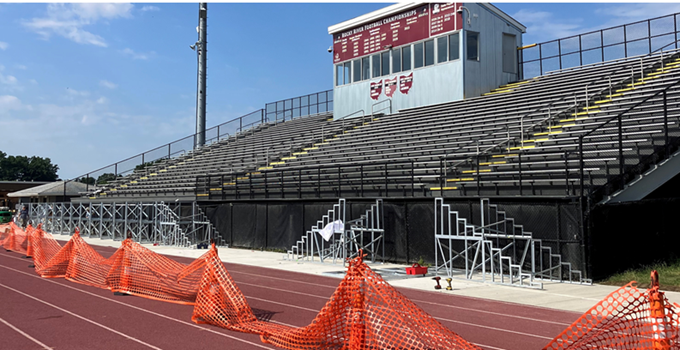
Photo by Eric Pempus, Author of the article
A concrete landing and pathway at the bottom of the wheelchair handicap ramp was poured with incorrect dimensions. The error was discovered after an aluminum ramp was installed. To comply with ADA dimensions for wheelchairs access, the concrete contractor had to extend the size of the access area more than one foot and five inches in two directions on the ground. See below.
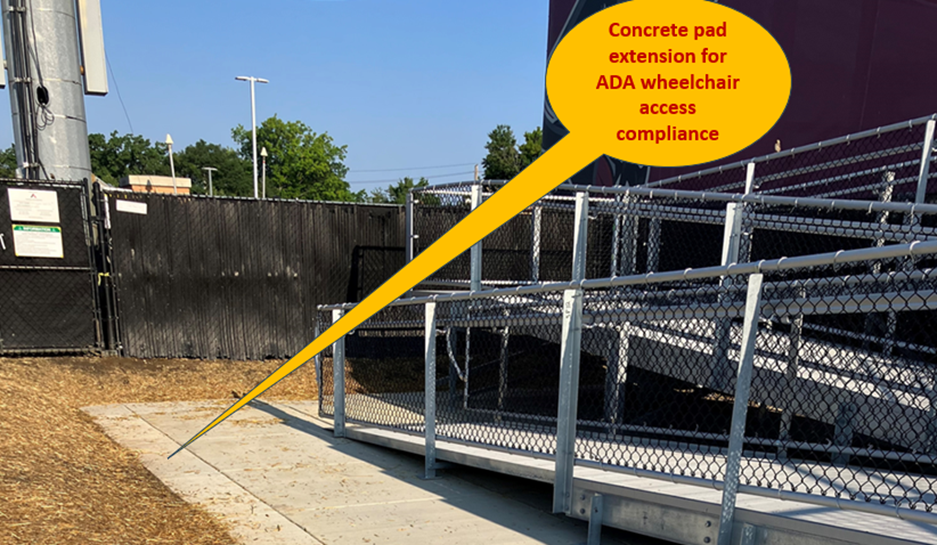
Photo by Eric Pempus, Author of the article
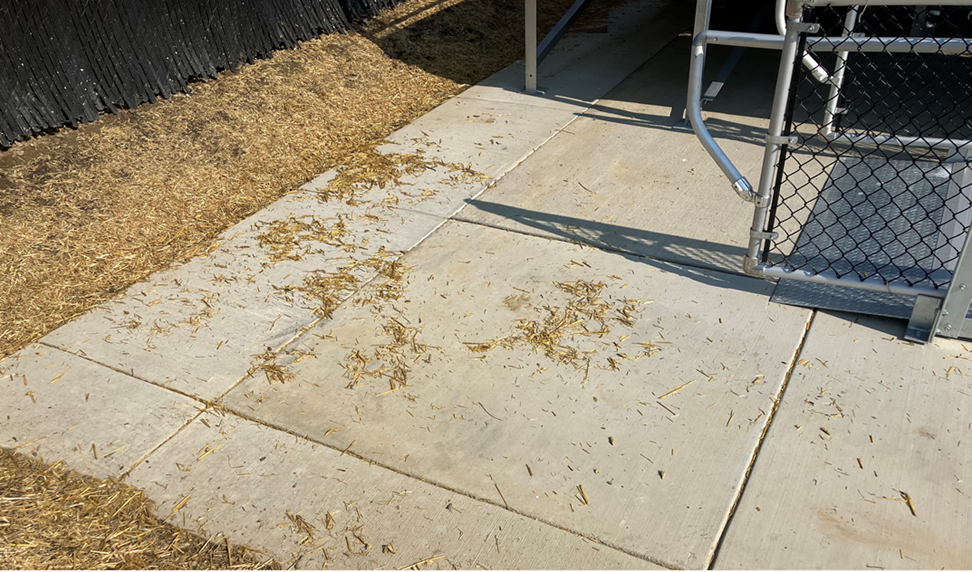
Photo by Eric Pempus, Author of the article
Using the three A201 Article 7 options of 1) a Change Order, 2) a Construction Change Directive, and 3) a Minor Change of the Work, consider the following:
Change Order (CO)
By agreement between Owner (in this instance—a school district), a concrete Contractor and the Architect for the ADA project, a change in the time to accomplish the work and extra cost for the labor and materials could be arrived upon. This agreement could happen even before the work is accomplished, or shortly thereafter.
Construction Change Directive (CCD)
Should there be a disagreement for the change in the concrete landing and pathway, the Architect would prepare a written directive for an adjustment of the time for the work, or the cost for the labor and material, or both. To complete the stadium seating project by the first high school football game of the season, at a later date, the Owner, Contractor and Architect would negotiate the final resolution of the time and cost involved. This keeps the project on schedule.
Minor Change in the Work (MCW)
If the change in the expanded concrete landing and pathway was such the contractor felt that the work was inconsequential, and there was no disagreement of time or cost, everyone would go on with other work to complete the stadium seating project with no issues.
RESULT OF THE ADA ACCESS CHANGE
Unfortunately, not knowing the result of the change, one could only assume that there was some sort of a Change Order. The extra excavation, concrete and reinforcing steel needed to comply with the ADA’s landing and pathway requirements, and the impending fall high school football schedule, was a relatively significant cost. For example, when two different concrete slabs are poured next to each other, there is a possibility of differential settlement between the adjacent pours. To combat this effect, the contractor needed to drill and stall horizontal reinforcing rods (rebar) to tie together the two concrete slabs.
I Googled the school board’s meeting minutes during and after the concrete construction but could not discover if there was a cost for the change (there were several board resolutions that I cannot find that were probably involved). Fortunately, the error was discovered before the concrete contractor had finished other work for sidewalks at the site, so perhaps the impact on the project schedule was not major. In fact, the change was accomplished in plenty of time. As the author of this risk management article, I visited this stadium from time to time walking the track, to see the project unfold to its completion.

About the Author of this Risk Management Building Block Article
As a risk manager for the last 18 years for the design profession, Eric has experience in professional liability insurance and claims, architecture, engineering, land use, law, and a unique background in the construction industry. Prior to risk management, he has 25 years of experience in the practice of architecture/engineering, and as an adjunct professor teaching professional practice courses at the undergraduate and graduate levels for the last 35 years at Kent State University’s College of Architecture & Environmental Design.
As a Fellow of the American Institute of Architects and AIA National Ethics Council 2021 Chair, he has demonstrated his impact on architectural profession. He has presented numerous loss prevention and continuing educational programs to design professionals since 2000 on topics of ethics, contracts, and professional practice in various venues across the United States and Canada. He is a former member and chair of his city’s Board of Zoning & Building Appeals for 24 years, and is a licensed architect, attorney, and property & casualty insurance professional.
His educational background includes a JD from Southwestern University School of Law, Los Angeles; Master of Science in Architecture from University of Cincinnati; and BA in psychology/architecture from Miami University, Oxford, Ohio.
The above comments are based upon DesignPro Insurance Group’s experience with Risk Management Loss Prevention activities and should not be construed to represent a determination of legal issues but are offered for general guidance with respect to your own risk management and loss prevention. The above comments do not replace your need for you to rely on your counsel for advice and a legal review, since every project and circumstance differs from every other set of facts.
Disclaimer: The viewpoints expressed in this article are those of the author(s) and are not necessarily approved by, reflective of or edited by other individuals, groups, or institutions. This article is an expression by the author(s) to generate discussion and interest in this topic.