
In the old days, architects and engineers (A/Es) created “measured drawings” to document existing buildings in order to renovate or remodel a structure. Measured Drawings became the base documents from which a new set of plans, such as for a repurposed project. Design professionals would utilize an existing floor plan of the building, so that the drawings could note existing dimensions and features of the structure. In the absence of existing drawings (as many older buildings’ drawings are lost or otherwise unavailable), the A/Es would create a sketch of the layout of the location of walls, doors, windows, stairways, etc. Modernly, however, with the advancements of technology, we create instruments such as “laser scanners” to document existing conditions with assumed more accuracy than Measured Drawings.
MEASURED DRAWINGS
Defined as:
They are prepared during the process of undertaking a renovation or documentation of an already existing building. They are derived from the measurements taken of a standing building. These measurements and drawings are created from on-site project data.
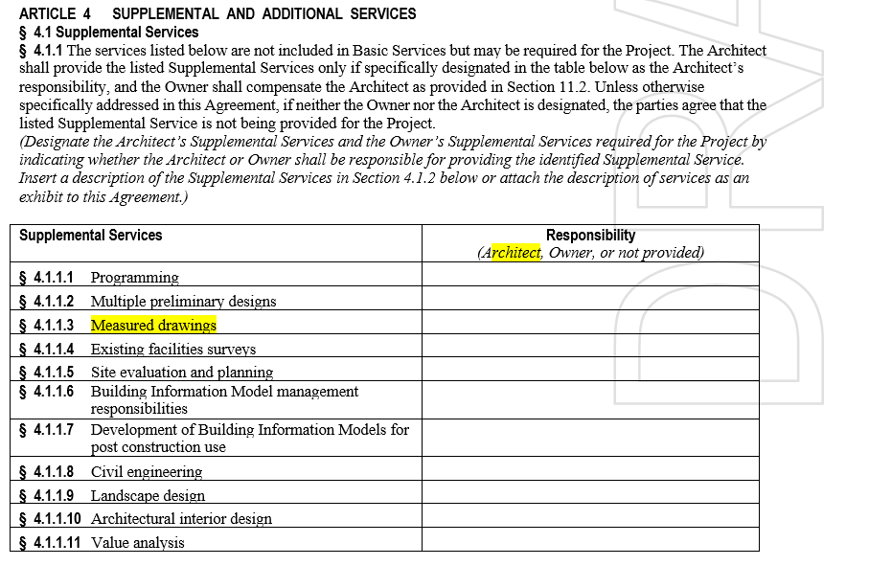
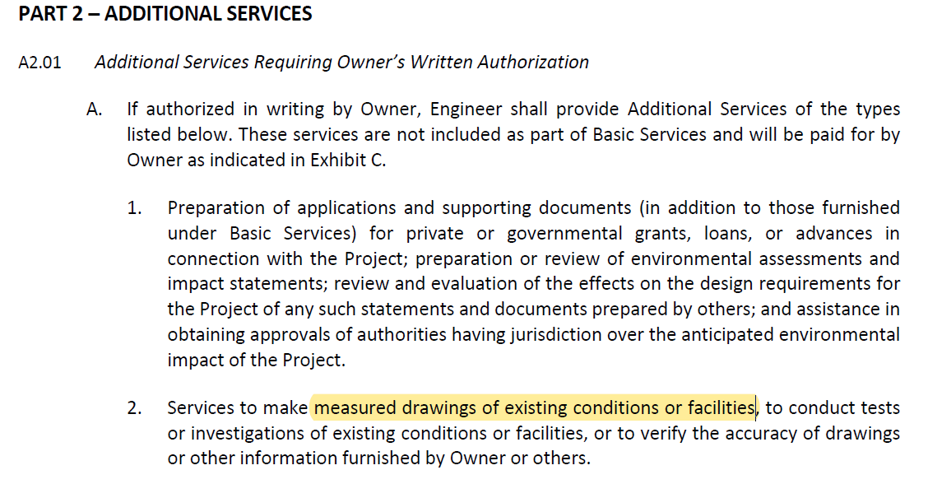
Measured Drawings are not needed in new construction. They are contemplated in both the American Institute of Architects’ (AIA) and Engineer Joint Contract Documents Committee’s (EJCDC) model agreements as an additional service, apart from the basic professional scope of services of an A/E.
Standard Form of Agreement Between Owner & Architect B101. They are included in Article 4 – Supplemental & Additional Services
Agreement Between Owner & Engineer for Professional Services, EJCDC E-500. They are included in Exhibit A – Engineer’s Services
LASER SCANNERS
Defined as:
Within the field of 3D object scanning, laser scanning (also known as LiDAR—Light Detection and Ranging) combines controlled steering of laser beams with a laser rangefinder. By taking a distance measurement at every direction the scanner rapidly captures the surface shape of objects, buildings and landscapes.
The concept of 3D laser scanning traces back to the early 1960s when researchers experimented with laser technology to measure distances and create 3D representations of objects. These early efforts laid the foundation for what would eventually become a game-changing technology. The use of laser scanning reduces data collection errors and the need to revisit a site due to missed detail. Primarily, it is used to develop 3D scans (or models) of building elevations, floor plans, tunnel profiling and motorway/rail bridges as well as mapping topography.
It is a distance-measuring technique that measures the travel time of a light pulse to and from an object and converts this to a distance. It is a distance-measuring technique that measures the travel time of a light pulse to and from an object and converts this to a distance. LiDAR and laser scanning are terms often used interchangeably, but they can have nuanced differences based on their application context. LiDAR is a broader term that encompasses the use of laser technology to measure distances and is used in various contexts, including airborne and terrestrial applications. With LiDAR, laser light is sent from a source (transmitter) and reflected from objects in the scene. The reflected light is detected by the system receiver and the time of flight (TOF) is used to develop a distance map of the objects in the scene.
IN CONCLUSION
Measured drawings will still exist for the purpose of remodeling or renovating existing buildings. Mainly because of the cost of laser scanners versus a hand sketch of an existing building. The cost of LiDAR—Elon Musk’s thoughts on the technology, from “The Verge:”
It’s a remarkable reversal for Tesla, which has famously winnowed down over the years the number of sensors it uses to power its advanced driver-assist features like Autopilot and Full Self-Driving—features that Musk has constantly sold as a precursor to a fully autonomous vehicle fleet. Later this year, Tesla is expected to reveal a robotaxi prototype on which Musk is betting the future of his company.
Musk’s LiDAR allergy was even on display during Tesla’s own quarterly earnings call, in which he boasted about how his vehicles only rely on camera-based vision systems to power their driver-assist features. “It is obvious that our solution with a relatively low-cost inference computer and standard cameras can achieve self-driving,” Musk said. “No LiDAR, no radars, ultrasonic. Nothing.”
https://www.theverge.com/2024/5/7/24151497/tesla-lidar-bought-luminar-elon-musk-sensor-autonomous
This quote is from the article “Elon Musk, Lidar Hater, Is Probably Going To Use Lidar In Teslas”
By Andy Kalmowitz
May 8, 2024
About the Author of this Risk Management Building Block Article
As a risk manager for the last 18 years for the design profession, Eric has experience in professional liability insurance and claims, architecture, engineering, land use, law, and a unique background in the construction industry. Prior to risk management, he has 25 years of experience in the practice of architecture/engineering, and as an adjunct professor teaching professional practice courses at the undergraduate and graduate levels for the last 35 years at Kent State University’s College of Architecture & Environmental Design.
As a Fellow of the American Institute of Architects and AIA National Ethics Council 2021 Chair, he has demonstrated his impact on architectural profession. He has presented numerous loss prevention and continuing educational programs to design professionals since 2000 on topics of ethics, contracts, and professional practice in various venues across the United States and Canada. He is a former member and chair of his city’s Board of Zoning & Building Appeals for 24 years, and is a licensed architect, attorney, and property & casualty insurance professional.
His educational background includes a JD from Southwestern University School of Law, Los Angeles; Master of Science in Architecture from University of Cincinnati; and BA in psychology/architecture from Miami University, Oxford, Ohio.
The above comments are based upon DesignPro Insurance Group’s experience with Risk Management Loss Prevention activities and should not be construed to represent a determination of legal issues but are offered for general guidance with respect to your own risk management and loss prevention. The above comments do not replace your need for you to rely on your counsel for advice and a legal review, since every project and circumstance differs from every other set of facts.
Disclaimer: The viewpoints expressed in this article are those of the author(s) and are not necessarily approved by, reflective of or edited by other individuals, groups, or institutions. This article is an expression by the author(s) to generate discussion and interest in this topic.