
It depends. Generally speaking, as long as the advertisement does not mislead, deceive or confuse the public, and it is done in good taste, yes. Other professionals do advertise as well. Lawyers and doctors do, but again, as long as it does not mislead the public, and it is done in good taste. Regarding architecture, the American Institute of Architects (AIA) does not consider the topic in their current 2020 Code of Ethics & Professional Responsibility. However, in the 1909 AIA code of ethics it did in rule #12.
Nonetheless, most state licensing statutes for architects have provisions in their Code of Conduct similar to the following:
Professional conduct. An architect shall not make misleading, deceptive, or false statements or claims.
ETHICAL OPINIONS ON ADVERTSING ARCHITECTURAL SERVICES
The following AIA National Ethics Council (NEC) advisory opinion addressed the question of advertising by architects. To be clear, the applicable AIA code of ethics’ rule has been included.
MISLEADING ADVERTISING
Advisory Opinion No.10, June 2004
QUESTION: Is it unethical for Firm A to use the photograph of a project completed by Firm B in a trade show booth bearing the name and logo of Firm A?
1997 Code of Ethics and Professional Conduct, Canon IV, Obligations to the Profession was applicable in 2004.
Rule 4.201 Members shall not make misleading, deceptive, or false statements or claims about their professional qualifications, experience, or performance and shall accurately state the scope and nature of their responsibilities in connection with work for which they are claiming credit.
Commentary: This rule is meant to prevent Members from claiming or implying credit for work which they did not do, misleading others, and denying other participants in a project their proper share of credit.
FACTS
1. While employed by Firm B, Architect C worked as lead designer on a youth recreation center.
2. Architect C left the employment of Firm B to work for Firm A. Architect C obtained from Firm B copies of photographs of certain projects with which he was involved while working for Firm B. He also obtained directly from the photographer copies of photographs of the youth recreation center project.
3. Four months after Architect C left Firm B, Firm A sent Architect C to exhibit at a national recreation and sports conference in a booth bearing the name and logo of Firm A.
4. The booth of Firm A prominently featured the photograph of the youth recreation center designed by Architect C while employed by Firm B. The photograph contained a three-line caption: the name of Architect C, followed by the word “Designer”; the name of Firm B as “Architect of Record”; and the name of the photographer as “Photo supplied by.”
5. Firm A and its then current employees did not have any involvement with the youth recreation center at the time of its design.
6. Firm A is headed by a Member in good standing of the Institute. Firm B is headed by a Member in good standing of the Institute. Architect C is a Member in good standing of the Institute.
DISCUSSION
The Preamble to the Code states, in red lettering, that “Rules of Conduct (Rule) are mandatory; violation of a Rule is grounds for disciplinary action by the Institute.”
The Council historically has displayed a very low tolerance level for any subterfuge or excuse regarding credit improperly claimed. Every AIA Member has an unassignable responsibility to make certain that credit is properly attributed.
The nature of a trade booth is that it casts forth to the passing crowd a high impact visual impression of the capability and experience of the design professional creating the marketing statement. At issue here, therefore, is a matter of the relative scale of the information contained in the booth of Firm A.
While Firm A followed the letter of the Code by giving correct credit to Firm B as the Architect of Record, it is undisputed that Firm A violated the spirit of Rule 4.201 by placing a burden on the beholder to enter the booth and peruse the photograph closely in order to discover that the “aisle” claim of Firm A to experience and expertise in the field of youth recreation facilities to some significant degree hinged upon a single project not executed by its firm.
In a commercial context where perception holds at least equal weight as fact, the Council takes a dim view of this type of avoidance of the duty that every Member voluntarily accepts under Rule 4.201.
CONCLUSION
Yes, it is unethical for Firm A to use the photograph of a project completed by Firm B in a trade show booth bearing the name and logo of Firm A. Firm A did not act ethically by encouraging the impression that it had direct responsibility for the design and construction of the youth recreation center project designed by Architect C while in the employ of Firm B. Furthermore, credit, to be credit, must be perceptible and easily read from the same viewing point as the “aisle” image demonstrating the expertise being claimed.
ETHICAL OPINIONS ON ADVERTISING ENGINEERING SERVICES
Copied below is a list of ethical opinions from the National Society of Professional Engineers (NSPE) — note that are a number of opinions on “advertising” by engineers. But not nearly as many opinions as last month’s Building Block risk management article on “conflicts of interest.”
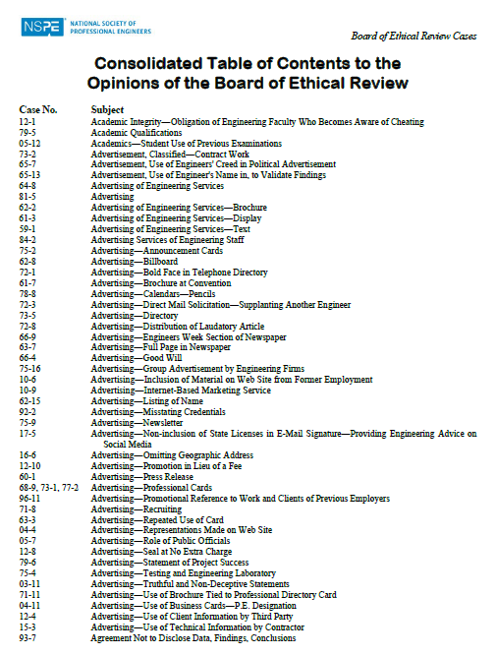
The following Board Ethical Review (BER) case addressed the question of advertising by engineers. To be clear, the applicable National Society of Professional Engineers’ (NSPE) rules of code of ethics have been included.
BER CASE NUMBER:
Case 03-11, Year: 2003
FACTS:
Engineer A is a principal in Topp-Flyte Engineering, a medium-sized engineering firm in South Northville, a medium-sized town. Engineer A’s firm’s engineers have received professional recognition by several South Northville engineering and technical organizations in the past year and in previous years. Recently Engineer A’s firm ran the following ad in a local newspaper:
“It says a lot when South Northville engineers recognize three members of one engineering firm in one year. It says even more when the same firm’s engineers are recognized for 18 years running. If you need engineering services, call the engineers other engineers have called the best: ‘Topp-Flyte Engineers,’ the best in engineering…”
QUESTION:
Would it be ethical for Engineer A’s firm, Topp-Flyte Engineering, to run the advertisement in a local paper?
DISCUSSION:
Professional advertising and the appropriate conduct relating to advertising has long been an issue within the field of engineering ethics. Throughout the history of the NSPE Board of Ethical Review, the BER has had occasion to decide a wide variety of cases relating to this issue. It is important to note at the outset, however, that as a general matter the NSPE Code of Ethics or other restrictions on non-deceptive advertising have been found to be unlawful by the United States Supreme Court and federal enforcement agencies. Therefore, it is clear that this Board may only pass upon advertising that is clearly deemed to be non-truthful or at the very least misleading and deceptive on its face.
As noted, while the issue of advertising has long been a subject of this Board, many if not most of this Board’s opinions relating to advertising were decided under an earlier version of the NSPE Code of Ethics, which at the time deemed as unethical certain types of advertising determined to be unprofessional, including “self-laudatory comments.” An example of such language was the early BER Case 64-8, where an engineering firm inserted in a magazine which circulated primarily to business subscribers a full-page advertisement, consisting of text and one simple illustration intended to depict savings in capital costs which could be accomplished by retention of an engineering firm.
The text of the advertisement emphasized through bold-face large type that there are two phases during the design of a process or a manufacturing facility where professional consulting engineering, available from competent firms, can save substantial amounts of money - (1) when the project is conceived and is ready for planning and preliminary design, and (2) when detailed plans and specifications for construction are started. The text concluded with a further statement on savings to the client: "Quality design and engineering on a professional basis, can save large amounts of capital funds for Clients.”* The asterisk is explained by a footnote in six-point type: "This applies whether (name of firm) does all the preliminary phase or reviews plans already developed by a company's own engineering staff." At the bottom of the full-page advertisement appeared the name and address of the firm in large type, and a partial list of clients in somewhat smaller type.
The engineering firm reprinted the advertisement in a format consisting of the cover of the issue of the magazine in which the advertisement appeared, the advertisement as originally published in the magazine, and the following statement on the facing page: "At (name of firm) we supply the basic services described in our advertisement in a special way. Our meticulous attention to detail from start to finish of a project has resulted in direct capital savings to our clients. Innovations in design which we have developed have resulted in greater efficiency and production than was originally expected. We are prepared to discuss some typical projects with you and to explore how you, too, might use our professional and engineering services advantageously and profitably."
In deciding that the advertisement by the engineering firm in its original form and the reprint containing the added objectionable statements was unethical, the Board noted that language of the additional quoted statement by the firm in the reprint of the advertisement was not in accord with the mandate of NSPE Code because it was self-laudatory in tone and implied superiority by the use of "our meticulous attention to detail," and "innovations in design which we have developed. . . ." The Board also noted that the first paragraph of the additional statement was also objectionable in that it stated that the firm supplied services "in a special way." The Board also noted that this type of language was not only self-laudatory, but tended to reflect unfavorably upon the dignity and honor of the profession.
We cite this early case to illustrate the dramatic changes that have occurred within the field of engineering since the Board’s rendering of its opinion in BER Case 64-8. In addition to changes in the legal landscape that render earlier NSPE Code language and BER opinions invalid, many other changes have occurred within the field of engineering that would raise significant questions regarding the propriety of such earlier BER opinions. Engineering practice has become much more commercial, competitive and market-driven, with marketing, sales, and advertising playing an increasingly more important part. With the increasing globalization of engineering practice and the heightened use of technology to deliver engineering services, it can be anticipated that this trend will continue for some time. It is clear that earlier notions about the propriety of advertising have become somewhat outdated and not in keeping with the current times.
The Board recognizes its continuing role to carefully evaluate situations involving non-truthful or misleading and deceptive advertising claims and notes that this will need to be determined on a case-by-case basis—following a careful evaluation of all of the facts and circumstances.
Turning to the facts in the present case, based upon the legal and ethical standards outlined, the Board is not convinced that there is any basis to believe that the claims made by Engineer A and Topp-Flyte Engineering involve non-truthful or misleading and deceptive advertising claims as the Board understands the term and as it has been interpreted as a matter of law. There is nothing in the NSPE Code of Ethics that prohibits “self-laudatory” advertising as may have been the case in the past. Moreover, based upon the facts that (a) Topp-Flyte Engineering has earned recognition for its achievements for many years, and (b) there is no indication in the facts noting that its statements are factually incorrect, the Board cannot conclude that anything in the Topp-Flyte advertisement constitutes non-truthful or misleading and deceptive advertising claims.
NSPE CODE OF ETHICS REFERENCES:
Rule I.3.
Issue public statements only in an objective and truthful manner.
Rule II.5.a.
Engineers shall not falsify their qualifications or permit misrepresentation of their or their associates' qualifications. They shall not misrepresent or exaggerate their responsibility in or for the subject matter of prior assignments. Brochures or other presentations incident to the solicitation of employment shall not misrepresent pertinent facts concerning employers, employees, associates, joint venturers, or past accomplishments.
Rule III.1.e.
Engineers shall not promote their own interest at the expense of the dignity and integrity of the profession.
CONCLUSION:
It would be ethical for Engineer A’s firm, Topp-Flyte Engineering, to run the advertisement in a local paper.
About the Author of this Risk Management Building Block Article
As a risk manager for the last 18 years for the design profession, Eric has experience in professional liability insurance and claims, architecture, engineering, land use, law, and a unique background in the construction industry. Prior to risk management, he has 25 years of experience in the practice of architecture/engineering, and as an adjunct professor teaching professional practice courses at the undergraduate and graduate levels for the last 35 years at Kent State University’s College of Architecture & Environmental Design.
As a Fellow of the American Institute of Architects and AIA National Ethics Council 2021 Chair, he has demonstrated his impact on architectural profession. He has presented numerous loss prevention and continuing educational programs to design professionals since 2000 on topics of ethics, contracts, and professional practice in various venues across the United States and Canada. He is a former member and chair of his city’s Board of Zoning & Building Appeals for 24 years, and is a licensed architect, attorney, and property & casualty insurance professional.
His educational background includes a JD from Southwestern University School of Law, Los Angeles; Master of Science in Architecture from University of Cincinnati; and BA in psychology/architecture from Miami University, Oxford, Ohio.
The above comments are based upon DesignPro Insurance Group’s experience with Risk Management Loss Prevention activities and should not be construed to represent a determination of legal issues but are offered for general guidance with respect to your own risk management and loss prevention. The above comments do not replace your need for you to rely on your counsel for advice and a legal review, since every project and circumstance differs from every other set of facts.
Disclaimer: The viewpoints expressed in this article are those of the author(s) and are not necessarily approved by, reflective of or edited by other individuals, groups, or institutions. This article is an expression by the author(s) to generate discussion and interest in this topic.