
Since a selected construction “project delivery method” directly impacts the success of a project, an understanding of which approach is central to design professional services. Architects’ and engineers’ (A/Es) clients rely heavily upon their design professionals for guidance about project delivery decisions, and A/Es must assist in determining which method best suits their own abilities and their clients’ needs. Each method is briefly discussed in this risk management article, including traditional Design-Bid-Build (D-B-B), Construction Management (CMa Advisor and CMc Constructor/At Risk), Design-Build (A/E or Contractor as lead, Integrated Entity and a Criteria Architect approach), and Integrated Project Delivery (IPD).
The contractual responsibility for advising the owner on the selection of a project delivery method is spelled out in the scope of services of an A/E in the American Institute of Architects Standard Form of Agreement Between owner & Architect B101 (2017) as follows:

PROJECT DELIVERY METHODS’ HISTORY
A project delivery method is a comprehensive process including planning, design and construction required to execute and complete a building facility or other type of project. Modernly, the separation of design and construction is a fairly recent development. Historically, there was no strong distinction between design and construction. One of the first signs of this separation can be found in the American Institution of Architects 1909 Canons of Ethics, Principle Number 8, which stated that the profession’s architects should not get their hands dirty with construction.
In the early 1900s it was recognized that architecture, along with engineering, are learned professions. The “design” professions are akin to the law and medicine professions, and as such, should be included in the universities throughout the country. This “ivory tower” approach survived until more modern wisdom has taken place after the last 100+ years, which now have established colleges of architecture and engineering, recognizing the various project delivery methods available.
THE METHODS
Traditional Design-Bid-Build (D-B-B)
This is the most traditional method of moving a design and construction project from its conception to completion, in a linear fashion. It involves a sequence of activities generally occurring in the following order: project conception, design (including schematic design, design development and construction document preparation), bidding the design and construction documents by construction contractors, and then construction of a project.
In D-B-B, the design and construction documents are completed prior to bidding and construction. A general contractor is then determined by the owner, by selecting one of the several bidders that have submitted a proposal to construct the project in a competitively environment. A variation of this theme is when the owner selects a single general contractor, usually after the submission of its qualifications, and the cost of the project is negotiated. If the negotiation is unsuccessful, the owner then moves on to the second choice general contractor.
Construction Management (CMa Advisor and CMc Constructor/At Risk)
A construction management project may take many forms of variation. Regardless of the variation, construction management is the process of applying professional management expertise to a design and construction project, for the purposes of managing the project extent, cost and schedule. Used on large and complex projects, extensive coordination is utilized between design disciplines and construction trades. Many times these projects’ owners have limited experience with regard to design and construction of their project. However, the additional fees paid to a CM is offset by removing the burden of the oversight of complex projects from the owner or the owner’s staff.
A CM’s background may come architecture, engineering or general contracting, and the universities are now offering focused construction management courses, curriculum and degrees. Depending upon how the owner has structured the project delivery, the CM is granted differing degrees of authority and responsibilities, taking into consideration how the project is organized and the agreements are arranged.
CMa Advisor
In this method, a CM is utilized when a professional serves as an agent or adviser to the owner. The role of a CMa is to advise the owner on the management of the design and construction of the project, in a sense of coordinating the activities of the various project participants. However, the CMa does not hold any contracts for construction, including labor or project materials.
CMc Constructor/At Risk
Unlike a CMa, the CMc does hold contracts with constructors (prime contractors—analogous to subcontractors). What sets this method apart to the traditional D-B-B, is that the CMc is engaged by the owner at the project inception, along with the architect and engineers, to utilize the CMc’s experience and expertise in construction for, among other responsibilities:
- constructability reviews during the design phases and preparation of construction documents,
- detailed cost estimating, and
- project scheduling.
In a word of explanation about “at risk.” The AIA uses the term “CMc,” whereas much of the construction industry uses the term “CM/At Risk.” “At risk” has been used because the CM can potentially be at risk when losing money if they have guaranteed to construct the project at a certain sum (analogous to a general contractor at risk for their bid not covering the actual cost of the project). Of course, the CM/At Risk could break even, or make a profit. Nonetheless, the terms are synonymous.
Design-Build (A/E or Contractor as Lead, Integrated Entity and Criteria Architect approach)
Probably the most attractive attribute to design-build is that the owner has only have one agreement for their project. Owners engage one entity to provide the design and construction, simplifying the building process, and avoiding any finger pointing if project issues arise between the designers and constructors. Like construction management project delivery, design-build has its own variations of the theme.
A/E as Lead
In this approach, an A/E engages a construction contractor. One aspect of this variation is that the A/E has to purchase general liability insurance to cover the construction activities, since they engaged the constructor. This is in addition to the A/E’s professional liability insurance costs. This extra cost of two types of insurance has dissuaded some A/Es from using this project delivery method. Other A/Es have embraced this variation, not only for expanding their business opportunities, but also enjoying having better outcomes from their projects.
Contractor as Lead
In this approach, a constructor engages project designers (architect and engineers). The construction industry has analyzed the percentage of who leads the design-build team. One study has concluded that construction contractors have been typically in the lead, engaging the design side of the project.
Integrated Entity
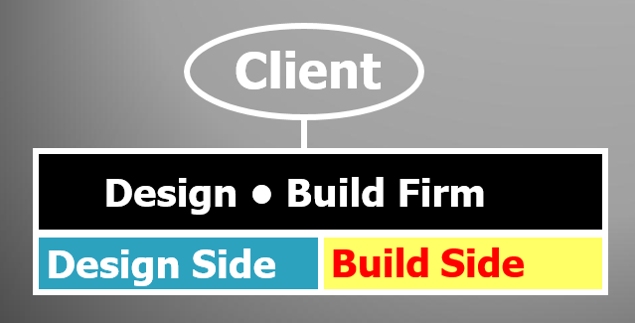
In this approach, the owner (the “client” in the diagram below) has contracted a design-build entity that has in-house abilities to both design and construct the project. Design-build firms will be larger entities that enjoy an even higher degree of control for project outcomes.
Criteria Architect (a.k.a Bridging Architect)
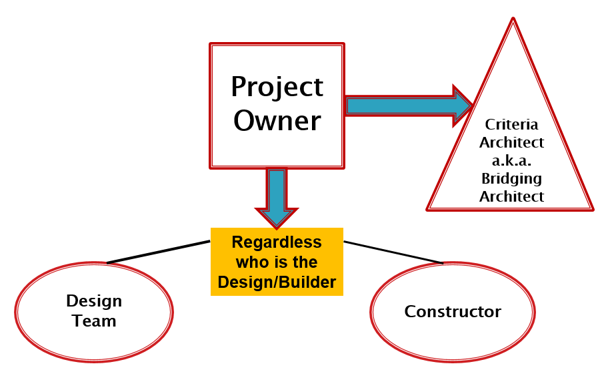
Regardless of who leads the design-build team (A/E, contractor or integrated entity), the owner may end up with several proposals to construct their building that have differing design solutions, and costs to build the project. If the owner is uncomfortable comparing the various design proposals and costs, this method has the ability to take the choice of “what is the best design solution” out of the equation.
The owner may engage a “Criteria Architect” to prepare a set of schematic documents, and “shop these documents around” to different design-builders. In this way, the owner is comparing apples to apples for the design, and only has to entertain which is the best design-builder based on cost. A question remains, is whether the Criteria Architect should remain in the project though construction administration, or peel off (step aside) for others to complete the work.
Integrated Project Delivery (IPD)
An integrated team comprised of the owner, A/E and constructor come together to deliver a project. This integrated team shares the profits and losses in the process, along with the risks and rewards. As defined by California AIA:
“IPD is a project delivery approach that integrates people, systems, business structures and practices into a process that collaboratively harnesses the talents and insights of all participants to reduce waste and optimize efficiency through all phases of design, construction and fabrication.”
CONCLUSION
The Design Build Institute of American’s “A Design-Build Done Right Primer” best states how project delivery method decisions are critical to the construction industry:

About the Author of this Risk Management Building Block Article
Eric O. Pempus, FAIA, Esq., NCARB has been a risk manager for more than 17 years with experience in architecture, law and professional liability insurance, and a unique and well-rounded background in the construction industry. He has 25 prior years of experience in the practice of architecture/engineering, and as an adjunct professor teaching professional practice courses at the undergraduate and graduate levels for the last 35 years. As a Fellow of the American Institute of Architects and AIA National Ethics Council 2021 Chair, he has demonstrated his impact on architectural profession. He has presented numerous loss prevention and continuing educational programs to design professionals and architectural students in various venues across the United States and Canada.
The above comments are based upon DesignPro Insurance Group’s experience with Risk Management Loss Prevention activities, and should not be construed to represent a determination of legal issues, but are offered for general guidance with respect to your own risk management and loss prevention. The above comments do not replace your need for you to rely on your counsel for advice and a legal review, since every project and circumstance differs from every other set of facts.
Disclaimer: The viewpoints expressed in this article are those of the author(s) and are not necessarily approved by, reflective of or edited by other individual, group, or institution. This article is an expression by the author(s) to generate discussion and interest in this topic.