
Before we discuss why, why not and how indemnification works in an agreement between project owner and their architect/ engineer (A/E), let’s first examine what this concept is all about. In its simplest terms, indemnification means to “compensate someone for harm or loss.” It is an undertaking by one party (the indemnifying party) to compensate the other party (the indemnified party) for certain costs and expenses, typically stemming from third-party claims. However, many project owners (actually project owners’ legal counsel) draft indemnifications to apply broadly, to include claims, damages, etc. stemming from allege causes by the A/E.
THE THEORY OF INDEMNIFICATION
Indemnification provisions allocate risk and liability among contractual parties. Typically, that allocation is designed to shift liability to the party who is thought to be more actively involved in activities or events giving rise to liability. In the context of professional service agreements, each party should be willing to be responsible for losses and claims arising out of its negligence. Words like “defend, claims, all suits, actions, attorneys’ fees, active, willful misconduct or breach of anything” are unacceptable to a design professional, because they can void the A/E’s professional liability insurance policy. If the Owner wants the A/E to have insurance, why would the Owner want to jeopardize the insurance coverage? Victor Insurance Managers, School of Risk Management
The American Institute of Architects’ Standard Form of Agreement Between Owner & Architect (2017), Document B101, does not include an indemnification clause. That is because the Architect shall compensate its client for the harm that the design professional causes without the need for an indemnification clause. In other words, there is no need for an indemnify clause for the benefit of a project owner since there is a contractual agreement, due to a standard of care that a design professional owes to its client. And, in addition, there is a common law duty to perform professional services within the standard of care, notwithstanding an indemnification clause.
On the other side of the concept, a project owner should indemnify their design professional in certain circumstances. Public entities cannot indemnify their A/E without encumbering a set amount of funds, which is indeterminable. However, for example, a private client should indemnify their design professional if the project owner would want to own the A/E’s documents created for the project.

DesignPro Insurance Group, Building Blocks July 2018 risk management monthly article.
BUT WHY OR WHY NOT?
Up to the early 2000’s, a typical American Institute of Architects (AIA) professional association agreement between a project owner and their A/E did not include an indemnification clause. Not until 2010, that is. At the end of this risk management article are excerpts from the Engineers Joint Contract Documents Committee (EJCDC) and AIA agreements with indemnification clauses between project owners and their A/E. But why, or why not?
At least for the AIA Document B101 (2017), without an acceptable clause, an Architect’s clients (actually the clients’ attorneys) were including onerous indemnification provisions. Thus, the AIA started including acceptable indemnification clauses in other owner-architect agreements. As such, the AIA started taking the “bull about the horns.” This is analogous to when the AIA started including the architect’s insurance provisions in the 2007 edition in the Owner-Architect Agreement (in the 1997 Owner-Architect Agreement there were no provisions for architects’ insurance). This is because prior to that the clients were imposing insurance provisions that an architect could not meet. The AIA started taking the “bull about the horns” making the clients to negotiate out of what the architect has for insurance coverages, when an architect established what insurance coverages that they included in an agreement that they proposed to their prospective client.
Before concluding this Building Blocks’ discussion, it is worthwhile to briefly review examples of what an acceptable and an unacceptable indemnification clause reads. However, bear in mind that there are many variations.
ACCEPTABLE SAMPLE PROVISION
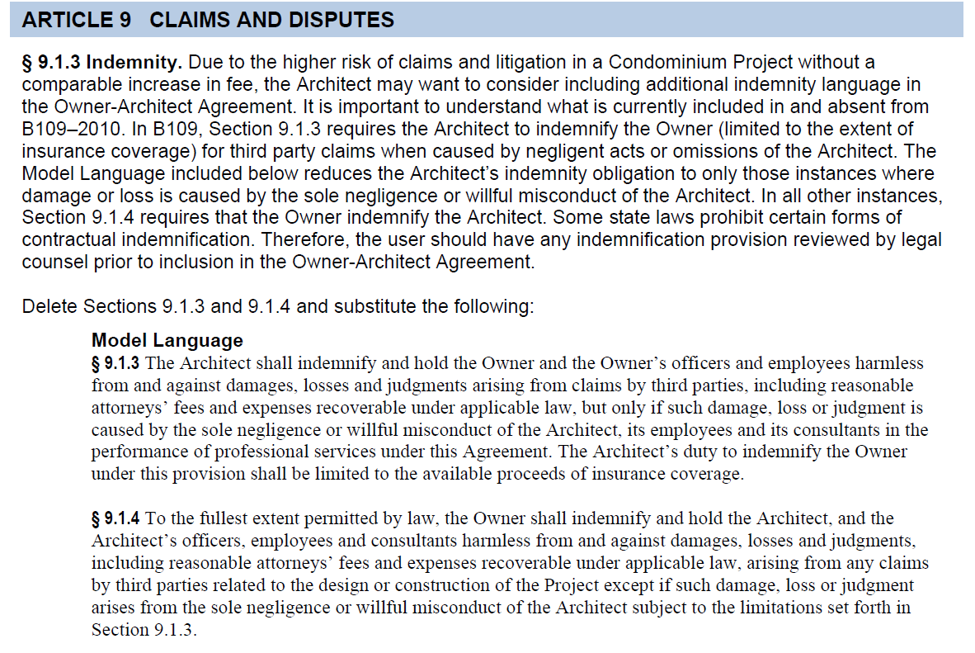
The Consultant (A/E) shall indemnify Client (project owner), its officers, directors, partners, employees, from and against losses, damages, and judgments only to the extent arising from claims by third parties, but only to the extent they are found to be caused by a negligent act, error, or omission of Consultant or Consultant’s officers, directors, members, partners, employees, or sub-consultants in the performance of services under this Agreement.
UNACCEPTABLE SAMPLE PROVISION
Words bold in red should be stricken and words bold in green should be inserted. Rationales are indicated below, but are not intended to be an exhaustive review.
To the fullest extent permitted by applicable law, the Design Professional must indemnify, defend, and hold harmless the Owner, the Owner’s Contractors, the Owner’s Separate Consultants, and their respective directors, officers, shareholders, members, employees, and agents from and against any and all claims, including breach of contract and warranties, damages, losses, fines, penalties, and expenses (including but not limited to all fees and charges of expert design professionals, attorneys, and other professionals and all court, arbitration, or other dispute resolution costs) to extent arising from third parties in connection with this Agreement, provided that any such claim, cost, damage, loss, fine, penalty, or expense is attributable to bodily injury, sickness, disease, or death, or to injury to or destruction of tangible property caused by the negligent acts, errors, or omissions of the Design Professional or a person or entity for whom the Design Professional may be liable; including complying with any and all laws whatsoever.
The above is an actual project owner’s (actually client’s attorney’s) indemnification clause, modified slightly.
- defend: the Design Professional should not be required to “defend” the Owner during a dispute even before the Design Professional is found at fault by a trier of facts
- Owner’s Contractors, the Separate Consultants: it makes no business sense for the Design Professional to indemnify anyone or any entity other than its client, the Owner
- agents: agents could be construed to be the Owner’s attorney, and that would make no sense
- any and all claims: means every claim, including breach of contract and warranties, frivolous claims, etc., and is so far reaching
- fines, penalties: these may not be covered by the Design Professional’s liability insurance policy
- (including but not limited to all fees and charges of design professionals, attorneys, and other professionals and all court, arbitration, or other dispute resolution costs): these may not be covered by the Design Professional’s liability insurance policy
- including complying with any and all laws whatsoever: this means every possible law, such as OSHA, and a Design Professional is not responsible for project site safety, nor are all laws consistent with each or change even in course of a project
- to extent: the Design Professional should only be responsible for the percentage of the harm that they have caused
- negligent: the Design Professional’s professional liability insurance policy covers negligence, but no other cause of action like breach of contract
IN SUMMARY
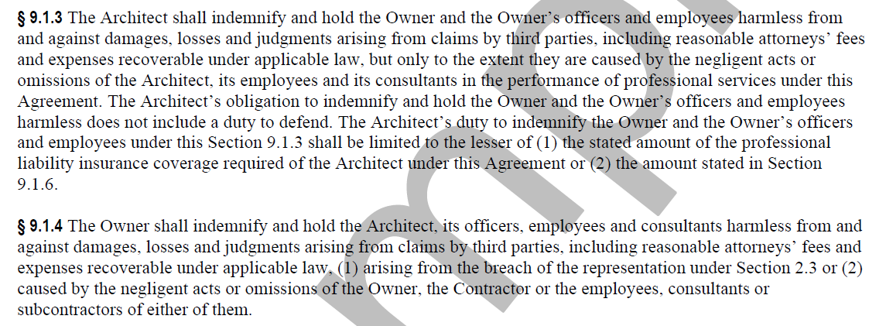
The following are examples of the use of indemnification clauses in the Engineers Joint Contract Documents Committee (EJCDC) and the American Institute of Architects (AIA) owner-A/E forms of agreements. In some instances, both the A/E and the Owner shall indemnify each other. And in other situations, only one would indemnify the other, depending on the project scope of services, project delivery method and project type.
6.11 Indemnification and Mutual Waiver
- Indemnification by Engineer: To the fullest extent permitted by Laws and Regulations, Engineer shall indemnify and hold harmless Owner, and Owner’s officers, directors, members, partners, agents, consultants, and employees, from losses, damages, and judgments (including reasonable consultants’ and attorneys’ fees and expenses) arising from third-party claims or actions relating to the Project, provided that any such claim, action, loss, damages, or judgment is attributable to bodily injury, sickness, disease, or death, or to injury to or destruction of tangible property (other than the Work itself), including the loss of use resulting therefrom, but only to the extent caused by any negligent act or omission of Engineer or Engineer’s officers, directors, members, partners, agents, employees, or Consultants.







About the Author of this Risk Management Building Block Article
Eric O. Pempus, FAIA, Esq., NCARB has been a risk manager for more than 17 years with experience in architecture, law and professional liability insurance, and a unique and well-rounded background in the construction industry. He has 25 prior years of experience in the practice of architecture/engineering, and as an adjunct professor teaching professional practice courses at the undergraduate and graduate levels for the last 35 years. As a Fellow of the American Institute of Architects and AIA National Ethics Council 2021 Chair, he has demonstrated his impact on architectural profession. He has presented numerous loss prevention and continuing educational programs to design professionals and architectural students in various venues across the United States and Canada.
The above comments are based upon DesignPro Insurance Group’s experience with Risk Management Loss Prevention activities, and should not be construed to represent a determination of legal issues, but are offered for general guidance with respect to your own risk management and loss prevention. The above comments do not replace your need for you to rely on your counsel for advice and a legal review, since every project and circumstance differs from every other set of facts.
Disclaimer: The viewpoints expressed in this article are those of the author(s) and are not necessarily approved by, reflective of or edited by other individual, group, or institution. This article is an expression by the author(s) to generate discussion and interest in this topic.