
It is not hard to imagine, even with the smallest building, that no construction project is built exactly without any changes from its design. That being said, this risk management article is meant to encompass the topic of all of the “Record Documents” for a construction project—not only drawings, but specifications, change orders, requests for information, etc. It had been common in the design and construction industry in prior decades that everyone called the project documents, edited to include changes during construction, the “As-Builts.” However, in these litigious times, it is best to be precise with what we call these project documents.
Using the term “As-Builts” may suggest that an architect or engineer (A/E) assures the project owner (their client) that they have reviewed all of the project documents to include each and every change made during construction, to accurately reflect all of the contractors’ work performed. Such review and assurances of the contractors’ work, to accurately reflect all of the changes in the documents, is well beyond the normal and reasonable scope of services of a design professional. In fact, an A/E may not be able to conduct such a review, apart from their client’s unrealistic expectations.
Should a design professional agree in their agreement with their client that they will provide “as-built” documents, it could be construed to be a warranty. Warranties are excluded from an A/E’s professional liability insurance. In fact, a design professional may likely not have insurance coverage for damages that result from someone’s unfounded reliance on the accuracy of the project documents. For example, such reliance could include facility maintenance, future remodeling of the construction project, or retrofitting the building to repurpose for another use.
The design professional’s agreement (along with all other project correspondence) with their client must make it clear that the documents supplied from the constructor are based upon a contractor’s information that has not been verified, and may be unreliable. To a jury or an unsophisticated client, the term “as-built” would mean just that—the project was built exactly that was depicted in the drawings, specifications and other project documents. Therefore, the term “Record Documents” is the best terminology to use.
Record drawings are documents compiled by the designer from the as-built drawings submitted by the contractor, as a record of the work. Since these are not confirmed in the field by the designer, they are not “as-built” but a compiled record. Record Documents reflect how the project was built—folding the as-built revisions into the design documents, including addenda, post- bid bulletins and design revisions. Cornell University Facilities & Campus Services
PROFESSIONAL SERVICE AGREEMENTS
The Engineers Joint Contract Documents Committee, EJCDC E-500, Agreement Between Owner & Engineer for Professional Services, states that:


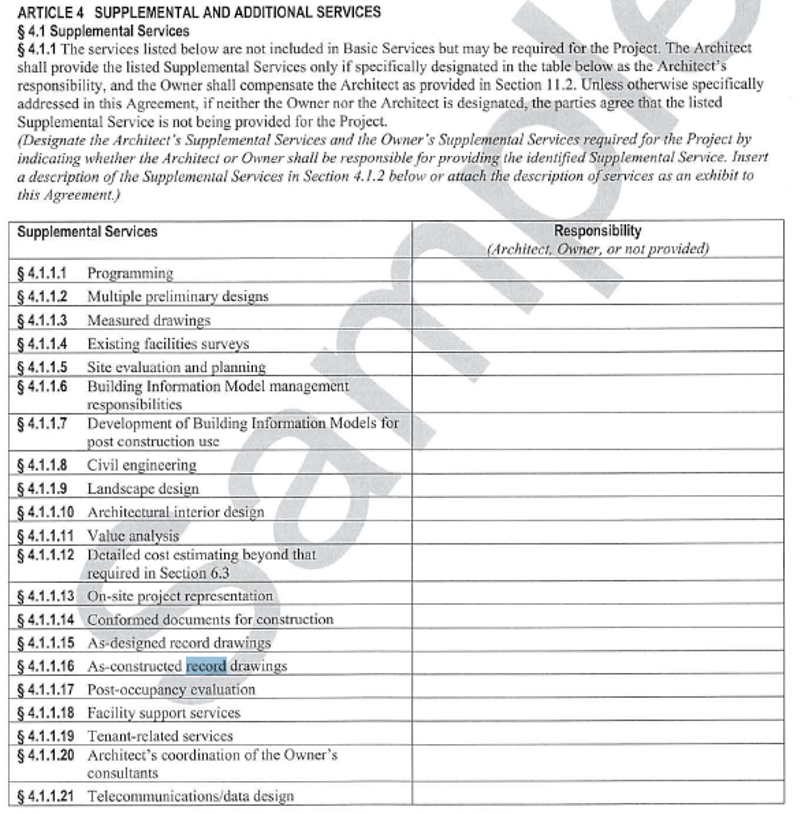
The American Institute of Architects’ (AIA) Standard Form of Agreement Between Owner & Architect, B101 (2017) states that the Architect will provide the following Supplemental Services if designated in the table below. Note the services § 4.1.1.15 and § 4.1.1.16 may involve the Architect if agreed to by the Owner and Architect.
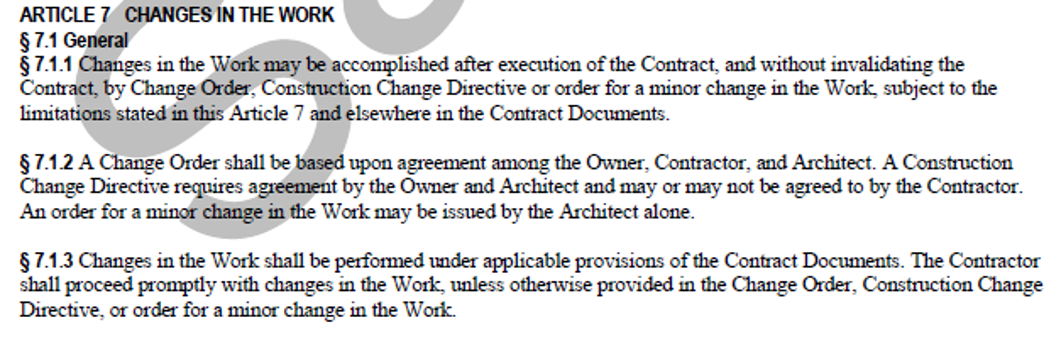
Changes to the design in a project are not only unusual, they are anticipated in construction. That is why the AIA’s General Conditions of the Contract of Construction, A201 (2017), states that:
Furthermore, should a design professional not be retained to provide construction phase services, it goes without saying that the A/E that would not want to be involved in compiling any documents showing deviations from the project’s design. See the discussion of the DesignPro Insurance Group’s risk management Building Blocks article “Design Without Construction Administration Services & Construction Administration Services Without Design,” September 2021.
CONCLUSION
To be clear, if the design professional is required to review and compile the construction documents, it is critical that the contractor has specifically identified everything contained in them that deviates from what was originally design for the project.
About the Author of this Risk Management Building Block Article
As a risk manager for the last 18 years for the design profession, Eric has experience in professional liability insurance and claims, architecture, engineering, land use, law, and a unique background in the construction industry. Prior to risk management, he has 25 years of experience in the practice of architecture/engineering, and as an adjunct professor teaching professional practice courses at the undergraduate and graduate levels for the last 35 years at Kent State University’s College of Architecture & Environmental Design.
As a Fellow of the American Institute of Architects and AIA National Ethics Council 2021 Chair, he has demonstrated his impact on architectural profession. He has presented numerous loss prevention and continuing educational programs to design professionals since 2000 on topics of ethics, contracts, and professional practice in various venues across the United States and Canada. He is a former member and chair of his city’s Board of Zoning & Building Appeals for 24 years, and is a licensed architect, attorney, and property & casualty insurance professional.
His educational background includes a JD from Southwestern University School of Law, Los Angeles; Master of Science in Architecture from University of Cincinnati; and BA in psychology/architecture from Miami University, Oxford, Ohio.
The above comments are based upon DesignPro Insurance Group’s experience with Risk Management Loss Prevention activities and should not be construed to represent a determination of legal issues but are offered for general guidance with respect to your own risk management and loss prevention. The above comments do not replace your need for you to rely on your counsel for advice and a legal review, since every project and circumstance differs from every other set of facts.
Disclaimer: The viewpoints expressed in this article are those of the author(s) and are not necessarily approved by, reflective of or edited by other individuals, groups, or institutions. This article is an expression by the author(s) to generate discussion and interest in this topic.