
The construction phase of a project is where the “rubber meets the road.” An architect/engineer (A/E) has many responsibilities while their project is being built. One of those responsibilities is to observe the work of their contractor(s).’ It does not mean that the A/E will guarantee the work will strictly comply with the design drawings and specifications, nor does it not mean that A/E has observed or inspected the work of every contractor on the project.
GENERAL OBSERVATION OF THE WORK OF THE CONTRACTORS
It does mean that A/E will generally observe that the work is in general conformance with the design intent of the project. That observation includes deciding issues as they arise relating to the construction of the project. That will include interpretations and decisions about how the work is progressing, the quality of the work, and changes in the work.
The American Institute of Architect’s Standard Form of Agreement Between Owner and Architect, AIA B101 (2017) states that:
§ 3.6.2.4 Interpretations and decisions of the Architect shall be consistent with the intent of, and reasonably inferable from, the Contract Documents and shall be in writing or in the form of drawings. When making such interpretations and decisions, the Architect shall endeavor to secure faithful performance by both Owner and Contractor, shall not show partiality to either, and shall not be liable for results of interpretations or decisions rendered in good faith. The Architect's decisions on matters relating to aesthetic effect shall be final if consistent with the intent expressed in the Contract Documents.
The Engineers Joint Contract Document Committee, Agreement Between Owner and Engineer Professional Services, Exhibit A, A1.05, Construction Phase, states that:
12. Clarifications and Interpretations: Accept from Contractor and Owner submittal of all matters in question concerning the requirements of the Construction Contract Documents (sometimes referred to as requests for information or interpretation—RFIs) or relating to the acceptability of the Work under the Construction Contract Documents. With reasonable promptness, render a written clarification, interpretation, or decision on the issue submitted, or initiate an amendment or supplement to the Construction Contract Documents.
13. Non-reviewable Matters: If a submitted matter in question concerns the Engineer’s performance of its duties and obligations, or terms and conditions of the Construction Contract Documents that do not involve (1) the performance or acceptability of the Work under the Construction Contract Documents, (2) the design (as set forth in the Drawings, Specifications, or otherwise), or (3) other engineering or technical matters, then Engineer will promptly give written notice to Owner and Contractor that Engineer will not provide a decision or interpretation.
The American Institute of Architects 2020 (most current version) Code of Ethics and Professional Conduct states that:

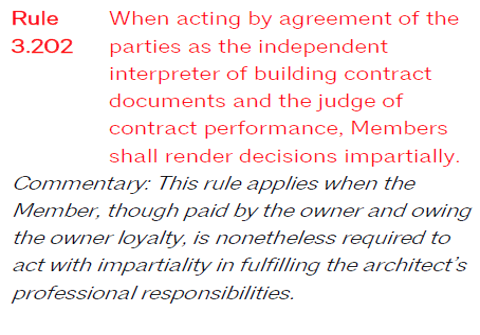
IN CONCLUSION
All the above being said, A/Es have a professional and ethical obligation to be impartial when deciding issues between their client (the project owner) and the contractor(s) on their projects. Is the A/E the best person or entity to make these determinations? Who else is most familiar with the drawing and specifications (the contract documents) in order to review the built portions of the project? The best answer is, the A/E of Record of the project—the design professional that was responsible for preparation of the construction documents and is typically the person who has affixed their stamp and/or seal on the contract documents that were filed for the building permit.
About the Author of this Risk Management Building Block Article
As a risk manager for the last 18 years for the design profession, Eric has experience in professional liability insurance and claims, architecture, engineering, land use, law, and a unique background in the construction industry. Prior to risk management, he has 25 years of experience in the practice of architecture/engineering, and as an adjunct professor teaching professional practice courses at the undergraduate and graduate levels for the last 35 years at Kent State University’s College of Architecture & Environmental Design.
As a Fellow of the American Institute of Architects and AIA National Ethics Council 2021 Chair, he has demonstrated his impact on architectural profession. He has presented numerous loss prevention and continuing educational programs to design professionals since 2000 on topics of ethics, contracts, and professional practice in various venues across the United States and Canada. He is a former member and chair of his city’s Board of Zoning & Building Appeals for 24 years, and is a licensed architect, attorney, and property & casualty insurance professional.
His educational background includes a JD from Southwestern University School of Law, Los Angeles; Master of Science in Architecture from University of Cincinnati; and BA in psychology/architecture from Miami University, Oxford, Ohio.
The above comments are based upon DesignPro Insurance Group’s experience with Risk Management Loss Prevention activities and should not be construed to represent a determination of legal issues but are offered for general guidance with respect to your own risk management and loss prevention. The above comments do not replace your need for you to rely on your counsel for advice and a legal review, since every project and circumstance differs from every other set of facts.
Disclaimer: The viewpoints expressed in this article are those of the author(s) and are not necessarily approved by, reflective of or edited by other individuals, groups, or institutions. This article is an expression by the author(s) to generate discussion and interest in this topic.