
For our purpose relating to design professionals, “supplanting” defined, means to supersede (another) and to take the place of and serve as a substitute for, especially by reason of a need. Circumstances may arise, and an architect’s or engineer’s (A/E)’s services may not be completed, although they have already started. The reasons include, but are not limited to:
- the A/E legally cannot complete their services because the firm has gone out of business or through bankruptcy,
- the A/E cannot complete their services because the firm has gone through a material change, such as the death of a principal in charge of their firm, and the firm does not have the ability to complete the project’s services,
- the A/E’s services have been terminated by their client’s agreement with the A/E, or
the A/E had been engaged for one phase of services, but not subsequent phase(s).
CONSIDERATIONS WHEN A DESIGN PROFESSIONAL IS REPLACED BY ANOTHER
The very thought of supplanting another design professional is more than enough for many firms to say no, to take upon an uncompleted project. However, when an A/E would want to consider replacing another, the following considerations should be examined. And these considerations, such as the liability exposure of taking over an uncompleted project, apply to both the original A/E, and the subsequent design professional that replaces the prior.
The replacing A/E would have to follow up on the understandings of the project’s goals, decisions made and not made, and services in the form of documents already prepared. Unless the replacing A/E has an opportunity to discuss the project’s hand-off with the prior, the replacing professional would have to make certain assumptions to complete the project. And the hand-off’s particulars may not cover all of the project’s issues, and assumptions must be made down the road. Unfortunately, the replacing A/E may unwittingly be entering into a problem-plagued project.
The consultants of the prior A/E firm obviously have to discuss the hand-off with the replacing firm, including possible change of the consultants’ scope of services, fees, ownership of project documents, etc. And the entire project’s fee may need to be adjusted/renegotiated. It may be that the prior consultants do not want to continue with the replacing design professional.
When a design professional is supplanted, the project owner will likely pay a significant price in terms of both time and money. The project schedule is derailed, construction costs escalate and design budgets are blown. From the replacing A/E’s perspective, they may need to develop their fee with little regard to the remaining professional services costs, as the target to hit. Learning curve and document review costs, alone, will drive the fee higher. Consider a time and material (T&M) fee that brings the professional services fee in line to complete the project. At some point, however, the replacing A/E and the project owner may negotiate a fixed fee for project completion.
Other considerations include that the replaced design professional may have copyright rights for project documents already prepared. The replacing A/E must resolved this issue with the prior professional before taking on the project. The project owner should agree to indemnify the replacing A/E if any copyright infringement claims arise from the prior design professional. And for that matter, the project owner should indemnify the replacing design professional for all matters relating to the services, already and to be completed. That indemnity should include that the replacing A/E is entitled to rely upon the information “Provided by Others,” which is a typical provision in most professional association model agreements.
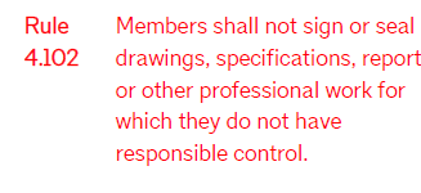
Another situation that must be resolved is—who seals and stamps the final project documents for building permit purposes? The replacing A/E, in order to do so, must be determined to be in “responsible charge” of the preparation of the documents “prepared under their direction and control,” which must be sealed and stamped. This situation is governed by state licensing laws and codes of ethics and professional conduct. For example, current 2020 American Institute of Architects Code of Ethics & Professional Conduct states that:
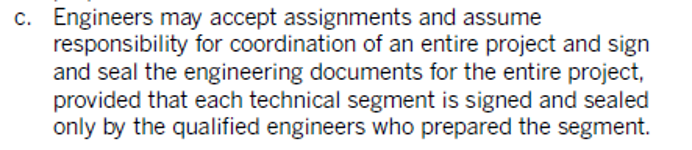
The current 2019 National Society of Professional Engineers’ Code of Ethics Rule of Practice II.2 states that:


Lastly, if a problem arises prior to project completion, or after completion, the question is—who is at fault? This will certainly generate finger pointing, and the possible need for informal or formal dispute resolution. The replacing design professional should plan for and anticipate the “worst-case-scenario.” Ultimately, the dispute may involve both liability and ethical issues, at the same time.
CASE STUDIES
The following two reported ethical cases (the first in engineering and the second in architecture), with similar facts, illustrate how supplanting another can involve issues that occur in the A/E profession, such as a design professional taking the place of a prior A/E.
Report on a Case by the Board of Ethical Review (BER)
National Society of Professional Engineers

Case No. 62-18: Supplanting
Facts:
Engineer “A” had a contract with a municipality for a feasibility study in connection with possible extension of the municipality's sewer system. He filed a report on the feasibility and probable costs of the extension system, for which he was paid. The city council did not act on the report. Several years later a new city council revived the project and called in Engineer “B” who reviewed the earlier report and entered into a contract with the municipality for a new engineering report and the design of the sewer extension system. Engineer “B” did not contact Engineer “A” to advise him of his retention for the work or to ascertain whether Engineer “A” still had any contractual relations with the municipality in relation to the project.
Question:
Was it unethical for Engineer “B” to negotiate a contract with the municipality knowing of Engineer “A's” previous involvement in the same project without notifying Engineer “A” of the facts and determining if Engineer ”A” had any remaining contractual relations for the project?
References:
Rules of Professional Ethics:
Canon 23 "He will not directly or indirectly injure the professional reputation, prospects or practice of another engineer."
Canon 25 "He will not try to supplant another engineer in a particular employment after becoming aware that definite steps have been taken toward the other's employment."
Canon 46 "He will not review the work of another engineer for the same client, except with the knowledge or consent of such engineer, or unless the connection of such engineer with the work has been terminated."
Canon 47 "He will not attempt to inject his services into a project at the expense of another engineer who has been active in developing it."
Discussion:
Canons 23 and 25 relate only to situations in which one engineer attempts to replace another engineer on a project, directly or indirectly. The portion of Canon 23 dealing with professional reputation is not involved in this case.
Likewise, Canon 47 makes it an offense against the Canons for an engineer to "inject" his services with regard to a project which another engineer has been instrumental in developing. "Inject" means "to throw in by way of suggestion" (Webster's New Collegiate Dictionary, 2nd .Edition). Hence, we look to the acts of Engineer “B” to determine whether he made the suggestion to the city council that he be employed for the work, and, if so, whether such injection of his interest was "at the expense of another engineer" who had been active in developing the project. “Develop" has many meanings, including disclosure or revelation, unfold more completely, evolve the possibilities of a situation, to make active something which is latent, to advance or further, and to promote the growth of a situation or project. Nothing in the Canons or Rules indicates the meaning which should be attributed to "developing" a project as referred to in Canon 47. In its context, however, we believe that the reference is to a set of facts whereby an engineering project has advanced to a certain point due to the work of a particular engineer by means of studies, designs, or research as to feasibility or economic considerations.
We have previously held that "definite steps" as recited in Canon 25 "means that the engineer has been informed by the client that he has been selected to negotiate an agreement for a specific project." (BER Case 62-10). Such "definite steps" had not been taken with regard to Engineer “A.” His earlier work had been completed and, having been paid for his work, he had no pending claim, nor was there any evidence or indication that he could expect the municipality to necessarily retain him for further work on the same project if it was later determined to proceed.
This leaves for decision the question of whether Engineer “B” was derelict ethically in reviewing the earlier report of Engineer “A” without advising him of that fact. Canon 45 imposes such a duty, except in a case in which "the connection of such engineer with the work has been terminated." The connection and the earlier work had been terminated in this case.
Conclusion:
It was not unethical for Engineer “B” to negotiate a contract in the absence of any showing that definite steps had been taken to retain Engineer “A” for the later work.
Board of Ethical Review: P. T. ELLIOTT, P.E. P. G. ELLIS, P.E. A. C. KIRKWOOD, P.E. W. S. NELSON, P.E. M. C. NICHOLS, P.E. E. K. NICHOLSON, P.E. L. R. DURKEE, P.E., CHAIRMAN
_________________________________________________________________
The American Institute of Architects
Code of Ethics & Professional Conduct, Advisory Opinion No. 5
Subject: Replacing Another Architect—Supplanting

Question: Did Architect “B” act unethically in replacing Architect “A” without notice to Architect “A”?
Facts:
Architect “A” was retained by an owner to provide master planning and schematic design services on a mixed-use, residential/retail building project. Architect “A” completed the master plan portion of the project and began schematic design. The relationship between the architect and the owner had been rocky, but they had worked through several disagreements about the best approach to the design challenges of the project. Their differences surfaced again during the beginning phases of schematic design. This time they were unable to resolve them. Architect ”A” stopped work and the owner refused to pay the balance of his fee.
Architect “B” was aware of the clashes between Architect “A” and the owner. When he heard about their latest disagreement, he arranged a meeting with the owner. Architect “B” told the owner that he would be interested in working on the project. The owner discussed that possibility with Architect “B” and decided that he felt more comfortable with Architect “B's” approach to the site. Without resolving the dispute with Architect “A,” the owner retained Architect “B” to redesign the project using as much of the master planning as possible, but with a new approach to the schematic design. Architect “B” did not communicate with Architect “A” before accepting the job.
The facts present a situation where one architect replaces another as the principal architect on a project. There was a time when the Institute's Code of Ethics prohibited a Member from accepting a commission for which another Member had already been employed, unless he had evidence that the previous commission had been terminated and written notice was given to the prior architect. This rule against "supplanting" was displaced in 1979 by interpretations of the antitrust laws. Professional associations, such as the AIA may not unreasonably restrict the freedom of their Members to pursue commissions from clients. Because of these judicial rulings, the AIA Code of Ethics does not include a rule on the subject of supplanting.
Since there is no ethical prohibition against supplanting, it was not unethical for Architect “B” to take over the project from Architect “A” at the invitation of the owner. Architect “B” was not required to provide any notice, oral or written, to Architect “A” that he was accepting the commission. Architect “B” was not required to determine whether Architect “A's” contract had been terminated.
IN CONCLUSION:
Replacing another architect on a project without determining that the other architect's engagement has been terminated and giving written notice is no longer a violation of the Institute's Code of Ethics. But, the withdrawal of the "supplanting" rule did not eliminate all ethical considerations, which may be raised by such an action. Legal and risk management considerations that existed at the time of the "supplanting" rule still exist.
The current AIA 2020 Code of Ethics & Professional Conduct has no rule regarding "supplanting” another AIA member. And for that matter, the current 2019 National Society of Professional Engineers’ Code of Ethics has no rule regarding "supplanting” another NSPE member.
About the Author
Eric O. Pempus, FAIA, Esq., NCARB has been a risk manager for more than 17 years with experience in architecture, law and professional liability insurance, and a unique and well-rounded background in the construction industry. He has 25 years of experience in the practice of architecture, and as an adjunct professor teaching professional practice courses at the undergraduate and graduate levels for the last 35 years. As a Fellow of the American Institute of Architects and AIA National Ethics Council 2021 Chair, he has demonstrated his impact on architectural profession. He has presented numerous loss prevention and continuing educational programs to design professionals and architectural students in various venues across the United States and Canada.
The above comments are based upon DesignPro Insurance Group’s experience with Risk Management Loss Prevention activities, and should not be construed to represent a determination of legal issues, but are offered for general guidance with respect to your own risk management and loss prevention. The above comments do not replace your need for you to rely on your counsel for advice and a legal review, since every project and circumstance differs from every other set of facts.
Disclaimer: The viewpoints expressed in this article are those of the author(s) and are not necessarily approved by, reflective of or edited by other individual, group, or institution. This article is an expression by the author(s) to generate discussion and interest in this topic.