
Before we define “scope creep,” let’s first discuss what the “scope” of the design of a construction project entails. The scope of professional services in the context of the construction industry—in simple terms, is what architects and engineers (A/Es) prepare for the design and construction documents, tailored to what a design professional and its client agree, in terms what is and what is not involved in the project. The scope identifies all the individual tasks, activities and deliverables for their projects.
And most importantly, in the agreement between an A/E and their client, there must be a scope statement. A scope statement can be found in professional association model agreements, such as published by the American Institute of Architects (AIA) or the Engineers Joint Contract Documents Committee (EJCDC). However, the scope can also fashion a custom statement, negotiated between the A/E and their client.
The scope of services may be very narrow, or very encompassing, or somewhere in between.
For example, as a limited scope of services may be the design and construction of a single family residence. (Actually, some would say that the design of a home is quite complex—the inhabitants work there, play there, sleep there, eat there, etc., but for our purposes let’s assume a home is a simple design).
On the other hand, a complex scope of services could involve the renovation of an existing k – 12 school involving phased construction, temporary administration and academic areas, hazardous material (asbestos and lead paint) abatement, adding new classrooms, swimming pool and gymnasium, parking lots and landscaping, new roof and windows. This complex project would involve architectural, landscape design and engineering design, including civil, geotechnical, structural, mechanical, electrical, and perhaps more specific acoustical and aquatic consulting services, and lastly construction administration.
A DIFFERENCE WITH DISTINCTION
And there is a difference between “scope of professional services,” and “scope of work” for the construction industry. It is important to use the word "services" and not "work" for what design professionals do, because the word "work" is most commonly used for what construction contractors do. A/E’s perform professional services. If there is a dispute on a project, it is critical to remove any doubt what design professionals do, compared to providing labor and materials to construct a project. People outside of the design and construction industry normally do not understand the difference between services and work. Moreover, it is common in client driven agreements between design professionals and their clients that the word “work” is synonymous with “services.”
SO WHAT IS SCOPE CREEP
Scope creep is what happens when changes are made to the project scope without any control procedure like change requests. Those changes also affect the project schedule, budget, costs, and resource allocation and might compromise the completion of milestones and goals. Scope creep is one of the most common project management risks.
Generally, scope creep occurs when new project requirements are added by project clients or other stakeholders after the project execution has started. Often these changes are not properly reviewed. Therefore, the project team is expected to complete more tasks, deliverables and milestones with the same resources and in the same time as the original scope. On the other hand, you could end up with a project with lots of approved, considered changes that never ends because every time you think you have finished, a new project requirement such as a new product feature arrives in your inbox and you have to make more changes. To control your project scope and prevent scope creep, you’ll need a scope change and risk management plan. Stephanie Ray, May 26, 2021.
https://www.projectmanager.com...
TO CONTROL SCOPE CREEP
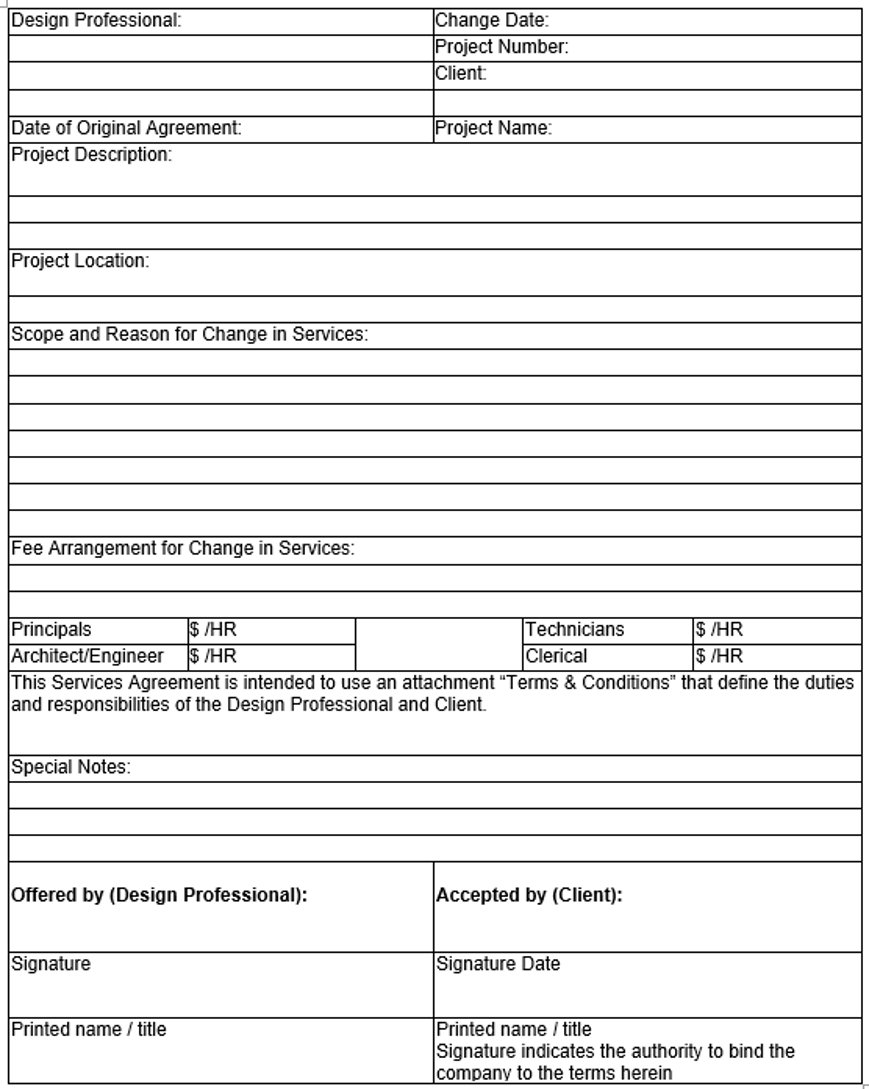
To develop a “scope change and risk management plan,” consider the utilization of a simple short form agreement to track changes in professional services, such as follows:
This is a sample agreement for your use and to modify as you see fit. Confer with your legal counsel that is knowledgeable in your state and other applicable state laws, to use in your design professional practice for risk management purposes, and this is not provided for legal advice.
IN CONCLUSION
Not every change in scope need be an increase in the client’s costs. In fact, it can be a deduction in the scope. While it is important to document every change in scope, perhaps an occasional ”No Change in Cost” for something relatively minor would be good client relations. Nonetheless, the impact of scope creep can not only affect an A/E’s profit and losses on the project, it can also increase project risks. The increased scope will bring with it additional exposures that were not anticipated at project interception.
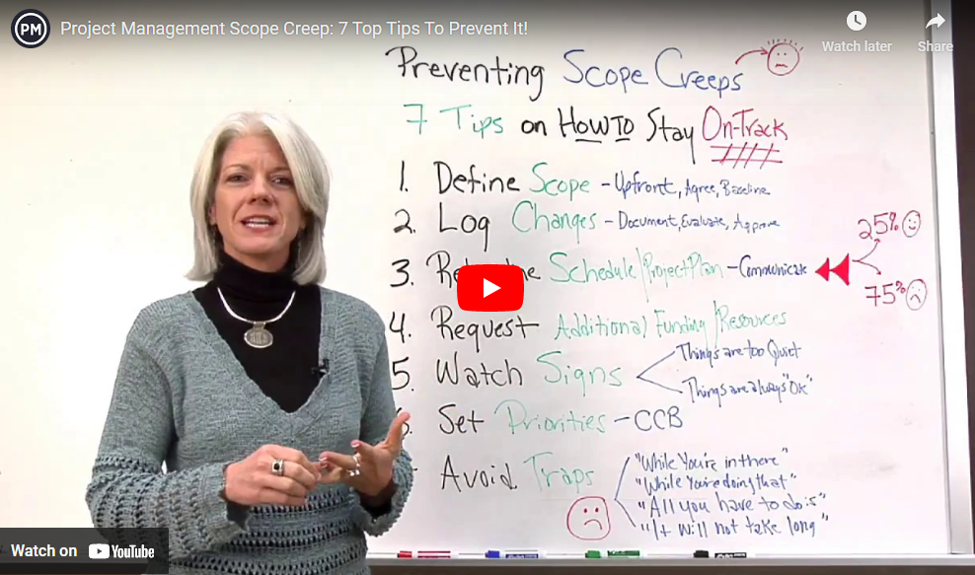
The following video can add to an A/E’s “scope change and risk management plan.”
https://www.youtube.com/watch?v=lKcJW1XqY4E
About the Author
Eric O. Pempus, FAIA, Esq., NCARB has been a risk manager for more than 17 years with experience in architecture, law and professional liability insurance, and a unique and well-rounded background in the construction industry. He has 25 prior years of experience in the practice of architecture/engineering, and as an adjunct professor teaching professional practice courses at the undergraduate and graduate levels for the last 35 years. As a Fellow of the American Institute of Architects and AIA National Ethics Council 2021 Chair, he has demonstrated his impact on architectural profession. He has presented numerous loss prevention and continuing educational programs to design professionals and architectural students in various venues across the United States and Canada.
The above comments are based upon DesignPro Insurance Group’s experience with Risk Management Loss Prevention activities, and should not be construed to represent a determination of legal issues, but are offered for general guidance with respect to your own risk management and loss prevention. The above comments do not replace your need for you to rely on your counsel for advice and a legal review, since every project and circumstance differs from every other set of facts.
Disclaimer: The viewpoints expressed in this article are those of the author(s) and are not necessarily approved by, reflective of or edited by other individual, group, or institution. This article is an expression by the author(s) to generate discussion and interest in this topic.