
Three “Rules of Thumb” regarding conflicts of interest for design professionals.
- Engineers and architects (E/As) cannot have two clients on the same project.
- E/As “should avoid even the appearance of impropriety” in their actions and practices. (This is a universal conflict interest and ethical precept beyond just E/As).
- Disclose all conflicts in writing immediately, if it is already present.
Typically, a conflict of interest occurs when an individual's personal interests–family, friendships, financial, or social factors could compromise a person’s judgment, decisions, or actions. Conflicts of interest are a clash that most often occurs between requirements and interests. Various types of conflicts of interest can occur because of the nature of relationships versus rules of organizations. This is a situation in which the concerns or aims of two different parties are incompatible.
Thus, conflict of interests should be avoided, but when avoidance is not possible or at least not reasonable, the conflict must be fully disclosed to all appropriate parties, and their consent must be won before an E/A can proceed. And, the disclosure and the consent must be in writing. A verbal “ok” is insufficient. So important is this topic, that all professional associations contain prohibitions in E/As’ codes of ethics and professional conduct, when they find themselves in such a conflict.
GUIDANCE FOR DESIGN PROFESSIONALS


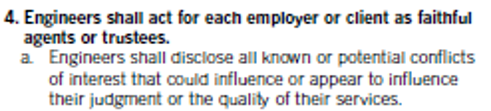

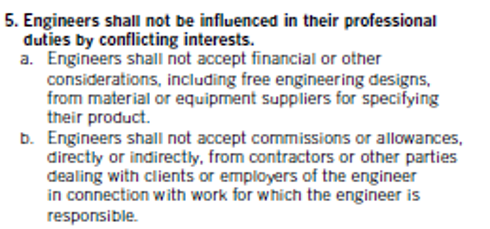

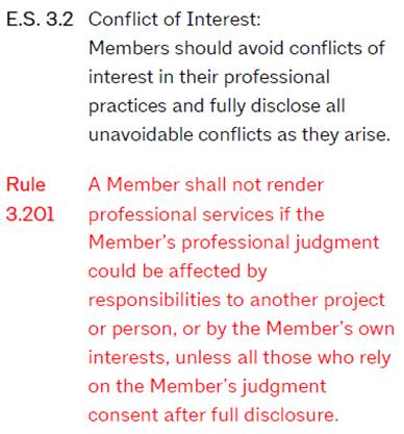
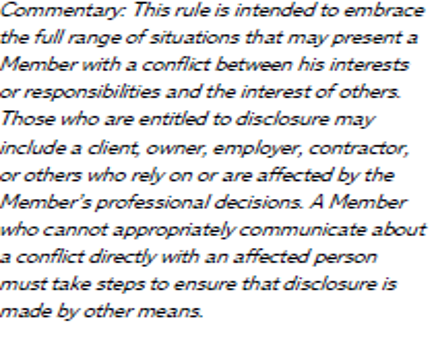
Not only in codes of ethics and professional conduct, but conflicts of interests is addressed also in model agreements such as the American Institute of Architects’ (AIA) Standard Form of Agreement Between Owner & Architect B101 (2017). “Except with the Owner's knowledge and consent, the Architect shall not engage in any activity, or accept any employment, interest or contribution that would reasonably appear to compromise the Architect's professional judgment with respect to this Project.”
EXAMPLES OF CONFLICTS OF INTEREST SITUATIONS
Case in point, an E/A in a conflict of interest situation, is as follows:
An E/A’s construction documents were sent out to selected general contractors to provide a bid on a particular project. A manufacture representative for a construction product is able to review the specifications from the general contractors, and finds that the manufacturer representative’s product is not in the E/A’s specifications.
As it turns out, the manufacturer’s rep’s product is not in the E/A’s typical specifications that is used on almost all construction projects that are designed by the E/A (called the office’s “Master Specs”). The manufacturer’s rep invites himself into the E/A’s office, and is allowed the opportunity to present the benefits of his product. As a result, the E/A puts the manufacturer rep’s product for use for future projects in the office Master Specs.
And as an exchange for the opportunity, the E/A allows the manufacturer rep’s product to be included into the instant project, in an exchange for a “thank you” gift to the E/A.
Even if the manufacturer rep’s product is substantially equal to the other alternate products that were specified by the E/A, the E/A should avoid even the appearance of impropriety in its actions and practices and, at the very least, not accept the “thank you” gift.
However, every situation is different. The National Society of Professional Engineers’ Board of Ethical Review, has numerous cases relating to conflicts of interests.
Case Number: 19-4 (2019)
Conflicts of interest present some of the thorniest ethical issues for engineers because the practice of engineering, by its very nature, involves relations with parties often with conflicting interests. Professional engineers are often faced with conflicts of interest in their professional practice.
Case Number: 85-6 (1985)
Engineer was retained by the state to perform certain feasibility studies relating to a possible highway spur. The state was considering the possibility of constructing the highway spur through an area that was adjacent to a residential community in which Engineer’s property was located. After learning of the proposed location for the spur, Engineer disclosed to the state the fact that his residential property might be affected by the new spur and fully disclosed the potential conflict with the state. The state did not object to Engineer performing the work and Engineer proceeded with his feasibility study and ultimately recommended that the spur be constructed.
The American Institute of Architects’ (AIA) National Ethics Counsel (NEC) determined (Decision 93-5: Conflict of Interest–Pursuing Zoning Change for Client’s Property Located Adjacent to Architects’ Property, under the AIA Code of Ethics in effect in 1993) where:
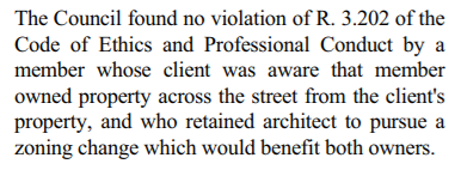
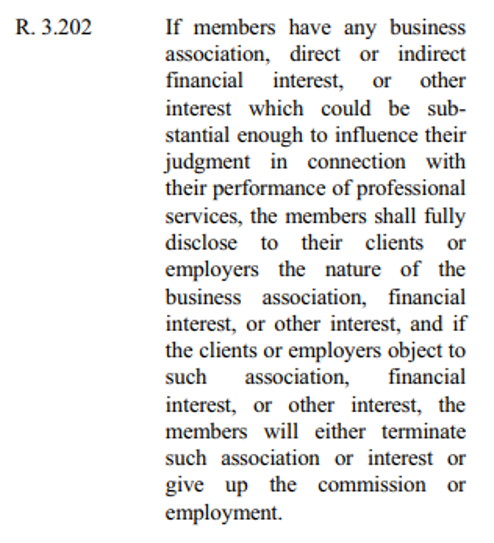
The evidence was clear that the client knew about the architect's ownership of the adjacent parcel of land and retained his services anyway. The evidence was also clear that the client continued to use the architect's services even after the rezoning hearing, in which the architect presented his proposal for use of his own property. The architect did not pursue his own project until the work he had agreed to perform for the client was completed, and many months had gone by with no word from the client. On this set of facts, the NEC concluded that the architect met all obligations under R. 3.202.
CONCLUSION
The question regarding the Master Specification example is–using professional judgment, should the E/A allow the manufacturer rep’s product into the instant project during the bid period (a common practice is to modify construction documents before bids are opened)?
If I was the E/A’s specification writer, I would avoid even the appearance of impropriety because the manufacture rep offered a bribe. But, it would be another professional judgement to allow manufacturer rep’s product into the office’s typical Master Specifications that is used on future construction projects that are designed by the E/A.
The bottom line, if the interest is enough to influence the E/A’s judgment, the E/A should fully disclose it in writing to their client (thus creating a paper or email trail).
About the Author
Eric O. Pempus, FAIA, Esq., NCARB has been a risk manager for more than 17 years with experience in architecture, law and professional liability insurance, and a unique and well-rounded background in the construction industry. He has 25 years of experience in the practice of architecture, and as an adjunct professor teaching professional practice courses at the undergraduate and graduate levels for the last 35 years. As a Fellow of the American Institute of Architects and AIA National Ethics Council 2021 Chair, he has demonstrated his impact on architectural profession. He has presented numerous loss prevention and continuing educational programs to design professionals and architectural students in various venues across the United States and Canada.
The above comments are based upon DesignPro Insurance Group’s experience with Risk Management Loss Prevention activities, and should not be construed to represent a determination of legal issues, but are offered for general guidance with respect to your own risk management and loss prevention. The above comments do not replace your need for you to rely on your counsel for advice and a legal review, since every project and circumstance differs from every other set of facts.
Disclaimer: The viewpoints expressed in this article are those of the author(s) and are not necessarily approved by, reflective of or edited by other individual, group, or institution. This article is an expression by the author(s) to generate discussion and interest in this topic.